Solve for Happy Summary: Mo Gawdat's Happiness Equation to Reset Your Mind
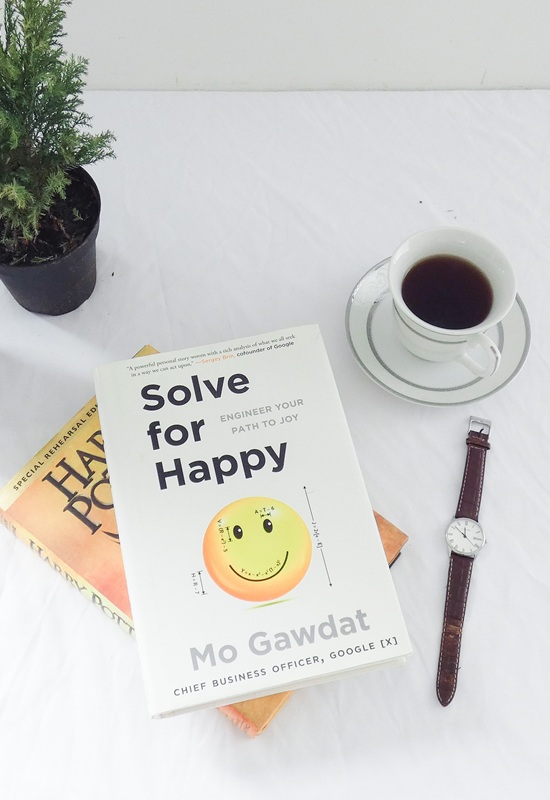
Imagine being a former Chief Business Officer at Google X, building self-driving cars and moonshot tech for a living — and still feeling, deep down, that something was off. That was Mo Gawdat. He had the income, the title, the family, the toys. And he was quietly miserable. So he did what any engineer would do: he treated happiness like a problem to debug.
Then in 2014, his 21-year-old son Ali died from a routine surgery gone wrong. And the equation Mo had been quietly working on for over a decade became the only thing holding him together. Solve for Happy is the result — and honestly, it's one of the most refreshingly clear-headed books on happiness I've ever read. No fluff. No spiritual bypassing. Just the math.
Happiness is the absence of unhappiness. It's your default state — the moment you stop interfering with it.
— Mo Gawdat, Solve for Happy
Prefer to watch? Here's the full breakdown ✨
What is the main idea of Solve for Happy?
Mo's core argument is wild but oddly liberating: happiness is your default state. You were born with it. Watch any toddler — they're not happy because life is going well. They're happy because nothing in their head is yet getting in the way.
Unhappiness, then, isn't something life does to you. It's something your mind generates in response to life — usually because reality didn't match the story you were telling yourself about how things should be. Fix the gap between reality and your expectations, and happiness shows up on its own. You don't need to chase it. You need to stop blocking it.
The happiness equation, explained
This is the heart of the whole book. Mo spent years collecting evidence and finally landed on a formula so simple it feels almost rude:
If reality matches (or beats) your expectations, you're happy. If it falls short, you're not.
Notice what this means. The events themselves aren't the problem. Two people can lose the same job, get the same diagnosis, hear the same "no" — and one will be devastated while the other is fine. The difference isn't the event. It's the gap between what happened and what they were silently expecting to happen.
So you have two levers, not one. You can change how you perceive what's happening (catch the distortions, see things more clearly), and you can adjust the expectations you didn't even realize you were holding. Most of us only ever try to change the events themselves — which is the one variable we often can't control.
The 6 grand illusions: what your mind keeps lying to you about
Mo argues there are six big illusions running quietly in the background of your mind, each one widening the gap between perception and reality. Until you see them, you'll keep solving for happiness in the wrong place.
-
The illusion of thought
You are not your thoughts. Your brain is a thought-generating machine that runs whether you want it to or not — and most of what it produces is repetitive, fearful, or just plain wrong. The first move is noticing that there's a you that observes the thoughts. That observer is the real you.
-
The illusion of self
The "self" you think you are — your job, body, relationship status, the highlight reel in your head — is a story, not a fact. When you stop confusing the story with who you actually are, criticism stops landing the same way and identity threats lose most of their power.
-
The illusion of knowledge
You know far less than your confidence suggests. Most of what you call "knowing" is assumption. Holding your beliefs a little more loosely makes you less reactive and a much better thinker.
-
The illusion of time
The past is a memory, the future is a projection — both exist only in your head right now. The actual only place anything ever happens is this moment. Time anxiety dissolves the second you genuinely accept that.
-
The illusion of control
You control a tiny fraction of what happens to you and almost nothing about the world around you. What you do control is how you respond. The grip you've been trying to keep is mostly an act, and letting go of it is a relief, not a loss.
-
The illusion of fear
Fear is mostly your brain rehearsing a worst case that hasn't happened. Real, present-moment threats are rare. Most fear is fiction — and once you start noticing how much of your day-to-day suffering is imaginary, it loses its grip fast.
The 7 blind spots distorting your perception
If the illusions are the lies, the blind spots are the lenses. They're the everyday cognitive habits quietly bending your view of reality — and inflating that gap in the equation. Mo's seven:
- Filters — your brain deletes most of what it sees and keeps only what fits your current mood or story
- Assumptions — you fill in the blanks (about people, motives, futures) and then react as if your guesses were facts
- Predictions — you forecast outcomes you can't actually know and feel the emotions of those imagined outcomes now
- Memories — you re-edit the past every time you recall it, then trust the edit as truth
- Labels — you collapse complex situations into "good" or "bad," "always" or "never," and lose all the nuance
- Emotions — strong feelings hijack your perception of what's actually happening in front of you
- Exaggeration — your brain makes everything more vivid and more catastrophic than it really is
Just naming these as you catch them in the act is half the work. "Oh — that's a prediction, not a fact." "That's a label, not the whole picture." Suddenly the panic loses about 80% of its weight.
The 5 ultimate truths to anchor yourself in
Once you clear out the illusions and dial down the blind spots, what's left? Mo points to five truths he argues are bedrock — things that, when you really sit with them, dissolve most chronic suffering at the source.
-
Now is real
This moment is the only moment that has ever existed. Your life isn't somewhere in the future you're rushing toward — it's literally happening right now. Most unhappiness is the cost of living anywhere else.
-
Change is real
Everything is in motion. Your body, relationships, mood, circumstances — all of it. Trying to freeze any of it in place is the recipe for suffering. Flow with it, and a lot of the resistance just stops.
-
Love is real
Of all the experiences a human can have, love is the one that consistently makes life feel meaningful. Mo argues it's not optional — it's the actual point. Choose it more often, especially with the people right in front of you.
-
Death is real
You will die. So will everyone you love. This isn't morbid — it's clarifying. Remembering it cuts through the noise of what doesn't matter and pulls you back to what does.
-
Design is real
The universe is too coherent, too elegantly built, to be pure accident. Whatever you call the intelligence behind it, trusting that there's a design bigger than you takes a huge weight off your shoulders. You're not the lone author of your life.
How to actually use this in your life
Catch the gap in real time
Next time you feel a wave of frustration, anxiety, or disappointment, pause and ask: what was I expecting that didn't happen? Nine times out of ten, you'll find a quiet expectation you didn't even know you were holding. Naming it is often enough to soften it.
Question the thought that's making you suffer
Mo recommends a simple test for any painful thought: is it true, is it helpful, and is there anything you can do about it right now? If a thought fails all three, it doesn't deserve another minute of your attention. That filter alone will quiet most of the inner noise.
Stop committing time treason
Notice how often you're physically here but mentally somewhere else — replaying yesterday or rehearsing tomorrow. Pull yourself back to this moment as many times as it takes. Real life is here, not in the simulation.
Choose love on the small scale, daily
You don't need a grand gesture. A real text. Eye contact. Listening without your phone in your hand. This is where life actually lives, and most of us are sleepwalking past it.
Solve for Happy Workbook & Summary PDF
Want to put the happiness equation to work in your own life? This free workbook walks you through the illusions, blind spots, and truths with prompts you can journal through this week.
Why this book hits differently in your 20s and 30s
This is the decade where most of us hit the quiet plot twist — the realization that hitting the milestones we were told would make us happy doesn't actually do it. The job. The relationship. The follower count. The apartment. You get the thing, and the relief lasts about a week. Then your mind goes hunting for the next one.
What Solve for Happy does so well is name that exact loop and show you the way out. Happiness was never on the other side of the next milestone. It was always available — you were just running an outdated script that kept manufacturing reasons it wasn't. Once you see the script, you can rewrite it.
You don't need life to be different to be happy. You need to stop demanding that it be different.
A final thought
The thing I keep coming back to with this book is how unflashy the answer is. There's no morning routine you have to perfect, no supplement to buy, no version of yourself you have to become first. The math was already there. You were just solving the wrong equation.
If anything in this resonated with you, do yourself a favor and read the full book — Mo's writing about his son Ali alone is worth the price of admission. And then, gently, start watching for the gap between what's actually happening and what you were quietly demanding life look like instead. That gap is where your happiness has been hiding the whole time.